PPC for Real Estate Investors: A Google Ads Guide
Quick answer: PPC for real estate investors puts paid ads in front of property owners searching for help selling a house. Start with seller-intent keywords in your service area, send each ad to a relevant landing page, and track calls, forms, and lead quality before you increase spend.
This guide covers keyword match types, bidding, ad formats, and campaign review. For help running campaigns, see our PPC management for real estate investors. For published examples, see our Results page.
Table of Contents hide
Introduction: Why Should Real Estate Investors Care About Google Ads?
Imagine a homeowner in your market types “sell my house fast” into Google.
You buy houses. They're thinking about selling one. Google Ads gives you a chance to reach them while they're looking for help.
That search doesn't tell you whether the deal will work. They might need to move next week, be shopping around, or want a price you can't pay and still make the numbers work.
Your job is to figure out which opportunities fit your business and what you can afford to spend finding them.
We'll work through keywords, ads, landing pages, bidding, and the numbers that tell you whether any of it is working.
Instant website traffic: Instead of SEO, you can start driving traffic to your site with PPC today. One significant benefit is that if you need leads (like, immediately), you can start driving traffic to your website and collecting leads (assuming you have a good website and are targeting the right traffic and running the right ad). Extremely measurable stats (even for novices): even if you’re a newbie, most PPC platforms (like Facebook or Google) will provide data and explanations of what each piece of data means.
For example, Google will break down in a simple, visual way how much each click is costing you, how many people have seen your ad, etc.\
Let’s put some numbers on this.
Say you spend $2,500 on Google Ads and get ten inquiries. That’s $250 per inquiry. If one of those ten people eventually sells you their house, you spent $2,500 in ads to get that deal.
These are made-up numbers, by the way. I’m showing you the math, not telling you what leads should cost in your market.
Now, it’s tempting to look at that one deal, decide PPC works, and crank up the budget.
Slow down a second.
You still need to account for management fees, other acquisition costs, and what you actually made on the deal. You also need to know what happened to the other nine people. Some might never sell. Others might still be in follow-up.
That’s why I want you to keep inquiries, qualified leads, and closed deals separate. Follow the leads you paid for through the whole process.
For an example, read Michael Lee’s PPC case study, including what he reported about lead volume, acquisition costs, and follow-up.
Otherwise, you’re making a decision about your marketing while half the story is still missing.
They can be improved over time: another benefit is that after you’ve figured out an ad set that brings you leads regularly, you can go to work, making it more efficient. That’s what we’ve done for years at Adwords Nerds, finding out things like what headlines convert better, what landing page layouts convert better, and more. By tweaking your ad content, audience, budget, campaign, and landing page, you can either raise or decrease the cost of each click or lead of your campaigns (reasonably).
Does this mean that Google PPC is ALWAYS going to be the best marketing channel for EVERY investor? Of course not. Competition varies, strategies vary, market conditions vary (I’m going to show you how to understand all of those later in this guide). But, for my money? Google PPC remains the single most powerful marketing channel in real estate investing, period.
PPC vs. Mailers: which is best for lead generation?
Countless investors may be asking, “Which is better: PPC campaigns or mailers?” Many investors expect me to come out and bash direct mail. After all, I’m the “Google Ads For Investors” guy, right? It isn’t like that at all. I think direct mail is an incredible marketing channel for investors. There’s a REASON that direct mail has been the primary marketing channel in REI for several decades.
So, which is best for you? It depends on your budget, your market, your website, and your goals. PPC will provide much more measurable data (how many people saw, clicked, converted, etc.), down to the penny, of what each lead is costing you. Another benefit of PPC is that you’ll be able to land in front of motivated sellers at the exact moment they’re searching for services like yours.
For example, if you use Google Ads (also known as Google AdWords) and run search campaigns for keywords like “sell house fast Cleveland,” then your ad will be shown to searchers exactly when they type that in and therefore are in a state of mind to click over to view your services. This is different from running Facebook ads, where you’re essentially interrupting them to tell them about your services.
Yes, they may be interested, but not at the moment. And mailers are the same way: you may indeed be targeting homes that are run down or in need of work or that are located within your targeted service area, but how do you know whether they are ready to sell or interested in what you offer? For this reason alone, I’d say that PPC has a leg up for its measurably and ability to end up in front of people at the right time.
But at the end of the day, it’s up to you. Finally, let me just say, you don’t have to think in terms of either/or. In other words, you can run PPC ads and run mailers. That’s what I encourage most of my clients to do. Now that you understand why Google Ads are such a powerful tool for finding motivated seller leads, let’s start at the beginning: What is Google PPC, anyway?
What ARE Google Ads, Anyway?
What ARE Google Ads, Anyway? Whenever you start talking about Google Ads for Real Estate Investors, countless terms start getting thrown around. The whole thing can get confusing fast — not to mention that many investors regularly mix these terms up! To start, let’s define two critical terms: PPC and Google Ads. PPC stands for “pay per click” and is a type of direct, online advertising.
As the name suggests, it’s a method of direct marketing where you pay (auction or bid style) for every click over to your chosen URL. “PPC” is a generic term. If someone says they’re doing “PPC,” that could mean a variety of things: that they’re running ads on Facebook, or Microsoft Ads (formerly known as “Bing,”), Google Ads, or ads on any number of lesser-known platforms (LinkedIn!
Reddit! Instagram! TikTok! etc.) “Google Ads,” or “Google PPC,” specifically refers to advertising on Google’s platform. Within the “Google Ads” umbrella, there are several advertising options: Google Search Ads, which are what most people think of when they think “Google Ads.” The ads displayed above and below the search results when you type something into the Google Search bar.
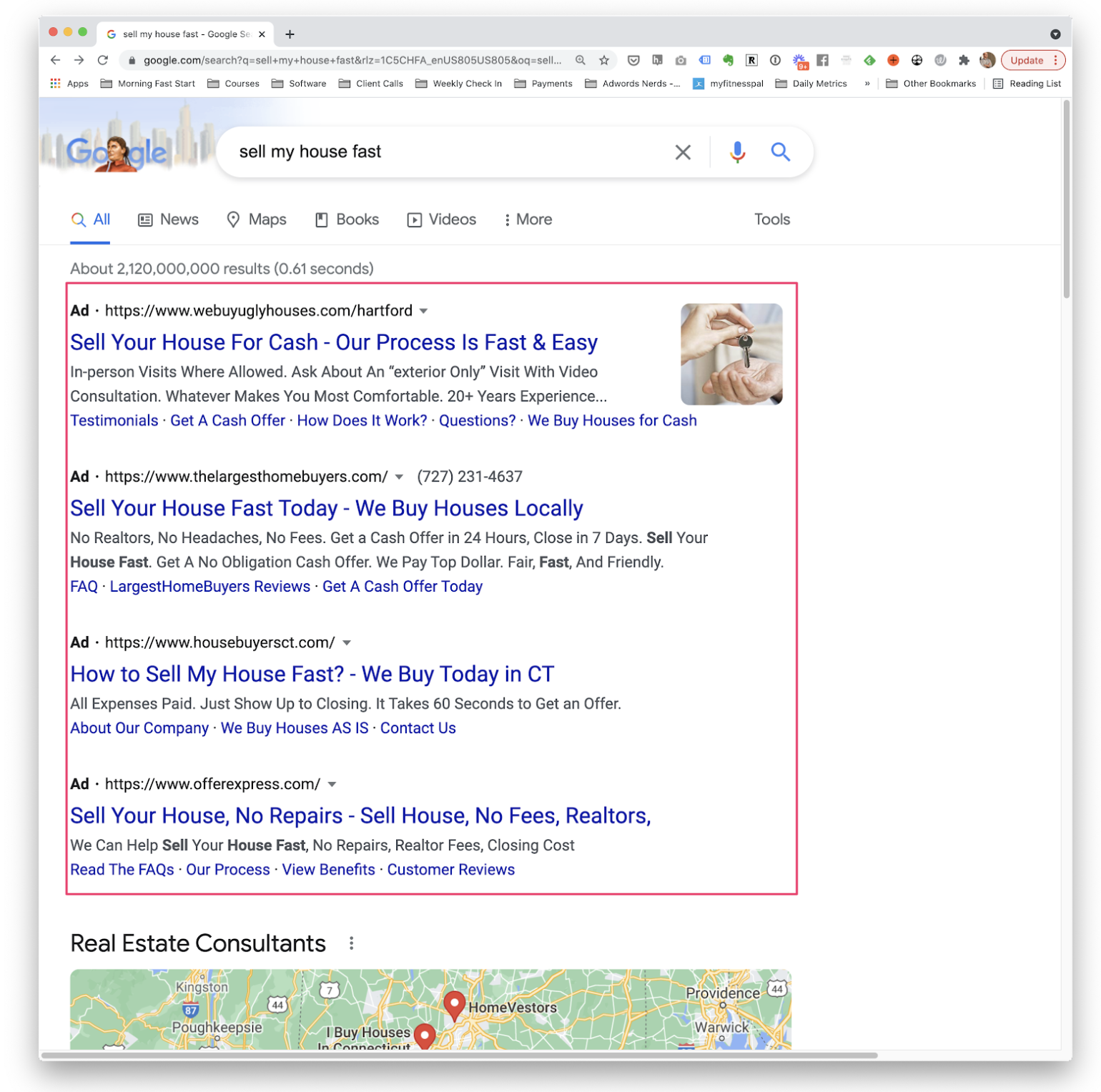
The image above shows a Google Search Engine Results Page (sometimes called “SERPs”). Everything in the red box are Google Search ads. However, Google Search Ads aren’t the only game in town. As part of a Google PPC campaign, you can include “Google Search Partners.” “Search Partners” includes ads that show up in reach results on non-Google sites. This is a pretty diverse group of placements, including anything from ads that show up in YouTube and Amazon search to sites like the New York Times or the Guardian, which use Google to power their in-house search functions.

(Image source) Google also offers the Google Display Network, which are third-party websites (i.e., not Google itself) that choose to show Google Ads somewhere in the layout of their site.
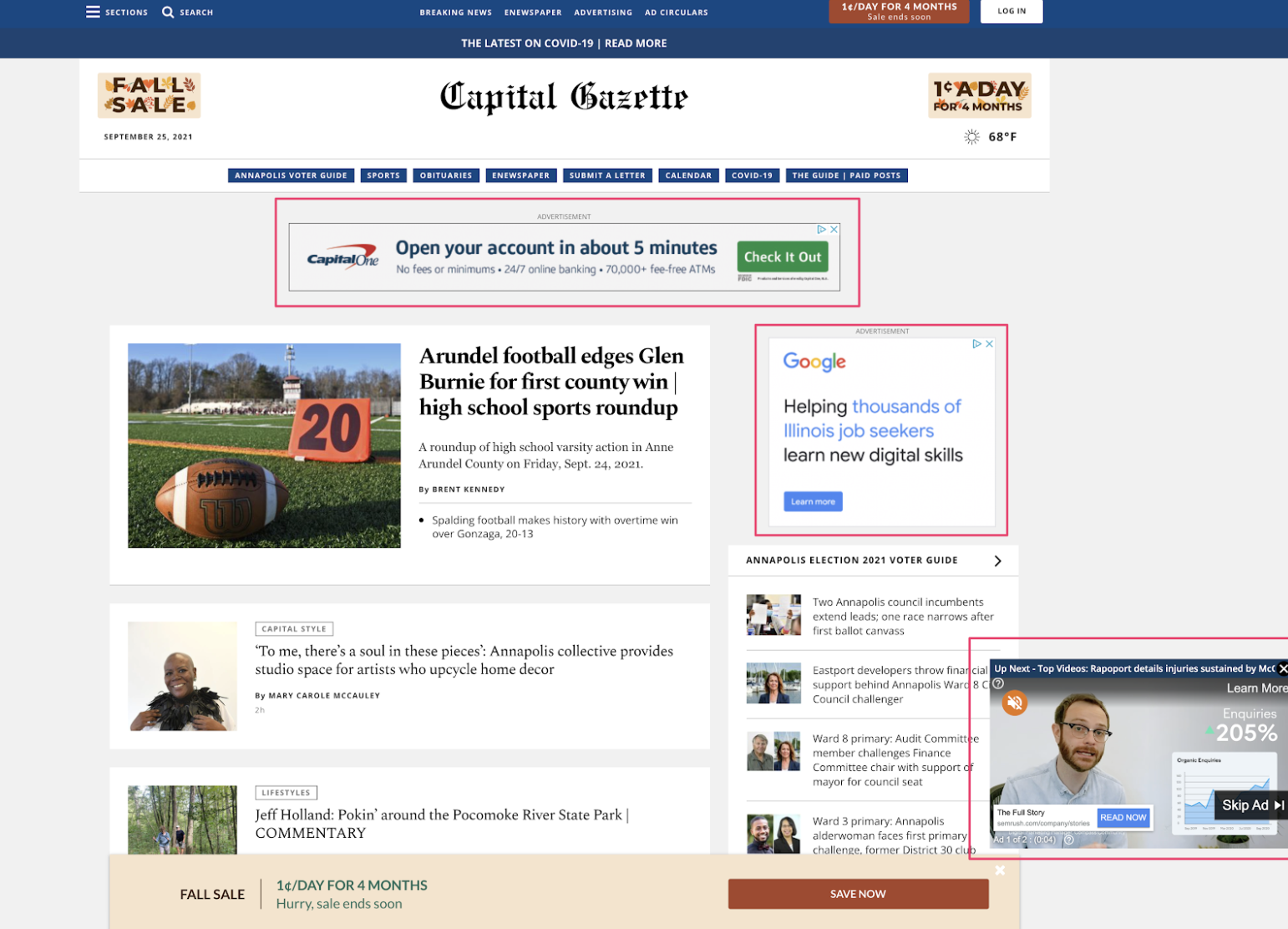
The above images show a website that includes Google Display Network ads. Everything in the red boxes is a Google Display Network ad. Google owns YouTube, and so Google Ads also include YouTube Ads as part of the Display Network.
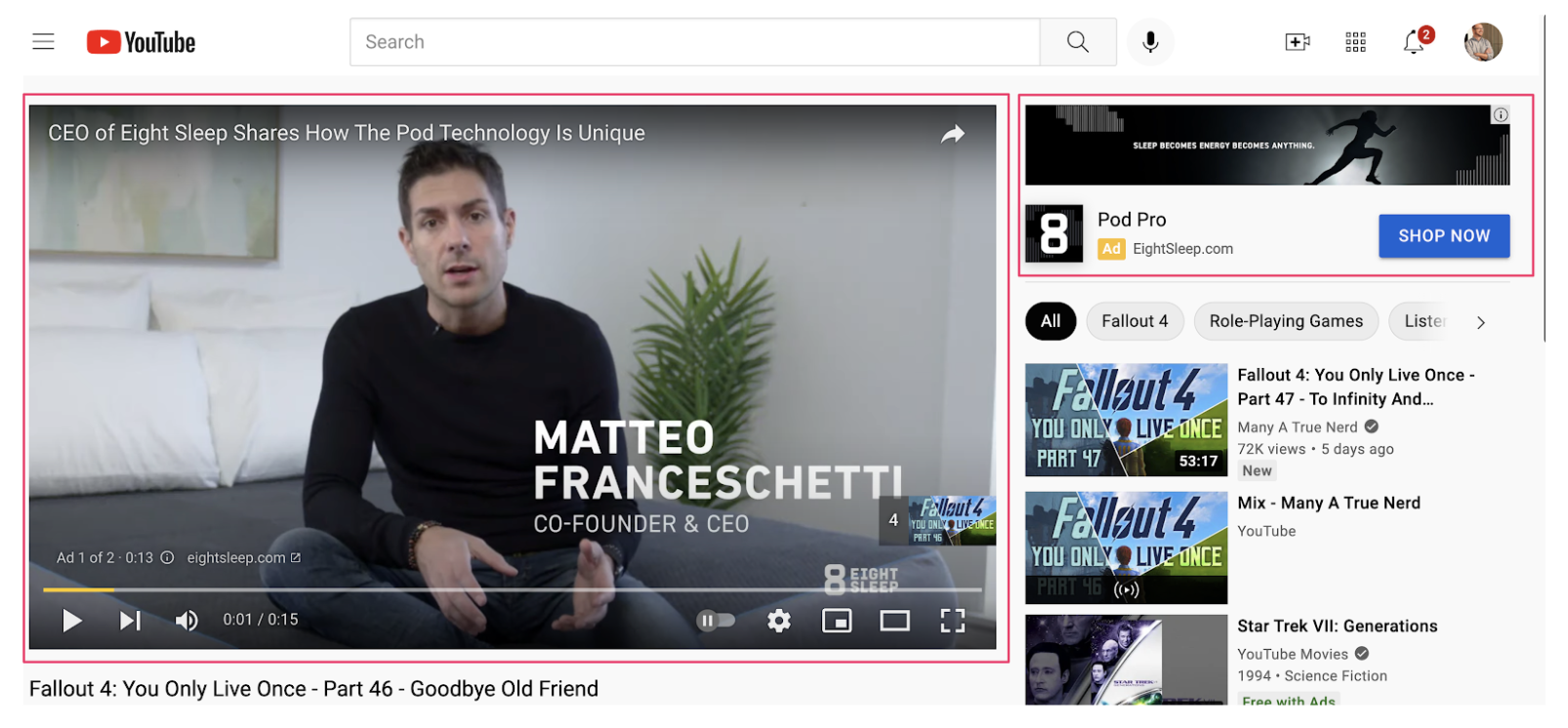
The above image shows examples of YouTube Ads. Everything in the red boxes is a YouTube Ad. I realize that’s a lot to keep track of, so let’s keep this simple: For most real estate investors, plain-vanilla Google Search Ads will be their best advertising channel. Why? The leads from Google Search are consistently better quality and close more often. Not only that, but Google search ads are relatively easy to set up (as opposed to YouTube ads, which require video production expertise).
For most investors, the best way to break into Google PPC for motivated sellers is to focus their budget and strategy on Google Search, then expand to other parts of the channel as things evolve. Now that we know what we’re talking about, Google PPC, let’s dive into HOW we target motivated sellers in Google Search.
Targeting Motivated Sellers: How Keyword Match Types Affect Lead Quality
How, precisely, do we target motivated sellers with Google Ads? Google Search Ads use keywords as their primary mechanism. Most people have a basic understanding of what keywords are and how they work — but the reality is a bit more complicated than that. To start, let’s discuss the difference between keywords and search terms. A “search term” is whatever someone types into Google. If I go on Google.com and type in “which president had a big hat,” that exact string of words is my search term. Straightforward, right?
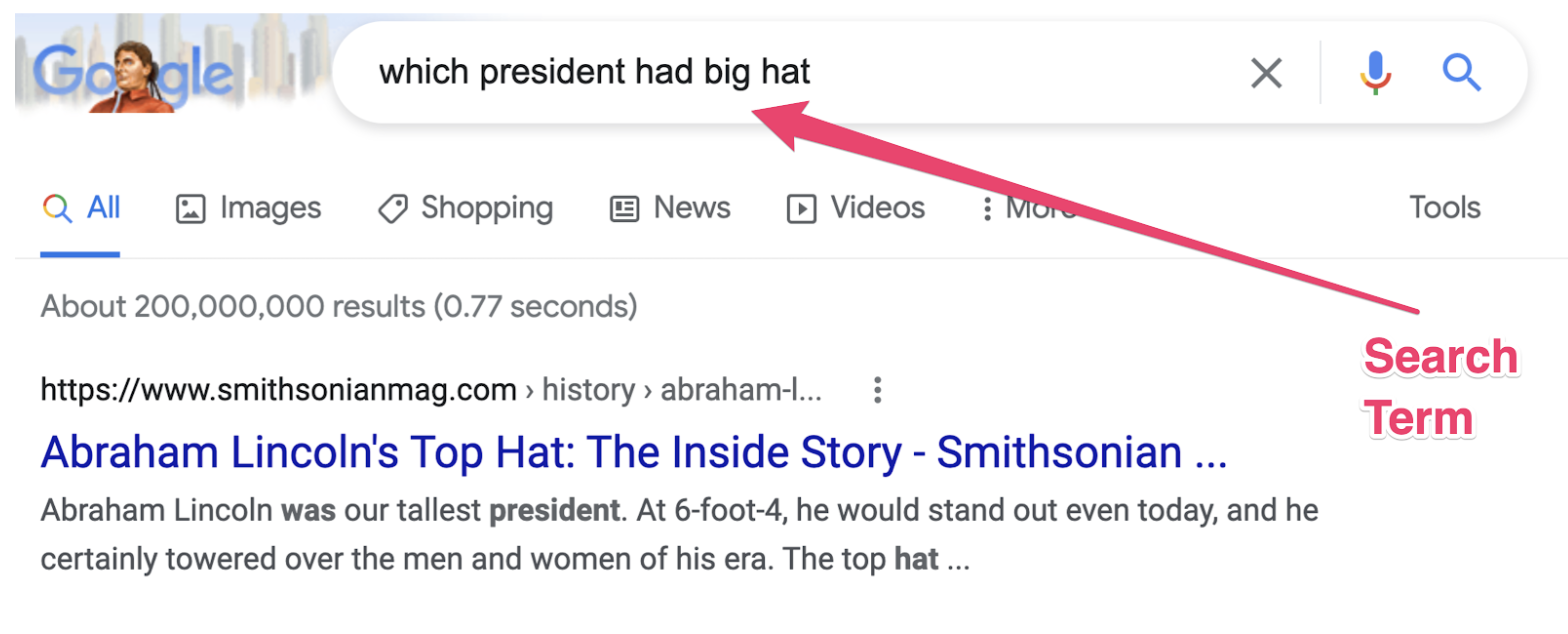
But keywords are different. Keywords are NOT what someone types into Google. A keyword is a way of telling Google what kinds of people we want to target with our ads. It’s a targeting mechanism, and for that reason, the way you use keywords will have a significant effect on the kind of results you get. There are a few different types of keywords. Using the proper varieties in the right contexts can be the difference between profitable, generating motivated seller leads and deals, and going broke. Let’s dig in.
Types of Keywords
There are three basic types of keywords you need to know:
- Broad Match Keywords (which are written without any punctuation, as in which president had big hat)
- Phrase Match Keywords (which are written inside quotation marks, as in: “which president had big hat”)
- and Exact Match Keywords (which are written inside brackets, as in: [which president had big hat])
Each keyword match type has a specific set of uses, as well as certain benefits.
Broad Match Keywords
Broad Match Keywords are the widest-ranging and most variable keyword type. You can think of a broad match keyword as a general theme. When you give Google a broad match keyword, it goes out and tries to match your ads with people using search terms that are broadly associated with that theme. For example, if you use the broad match keyword sell my house in a Google PPC campaign, your ad could be matched up with people searching for:
- sell house
- Zillow
- buy a house in my state
…and so on.
Google considers things like “Zillow” and “buy a house” as broadly related to the theme of “selling a house,” so all these searchers would be considered a match for your keyword. When should you use a broad match keyword? Use broad matches when you’re trying to generate as much volume as possible and are willing to accept some randomness as a result. Broad match keywords put you in front of the biggest possible audience…but they pull in some off-topic matches as a result.
Phrase Match Keywords
Phrase match can show your ad for searches that include the meaning of your keyword. The search does not need to use the same words in the same order. For example, the phrase match keyword “sell my house” may match a search such as “how to sell my home fast.” It can also match more specific searches about selling a house. Phrase match usually reaches more searches than exact match and fewer than broad match.
Check your search terms and lead quality to see whether the matches work for your business. See Google’s keyword match type guide for current rules and examples.
Exact Match Keywords
Exact match can show your ad for searches with the same meaning or intent as your keyword. It does not require the exact words. Square brackets mark an exact match keyword, such as [sell my house]. Exact match gives you the most control of the three match types, but it usually reaches fewer searches. For example, a search for “sell my home” may match [sell my house].
Always check the actual search terms, cost per lead, and lead quality before you decide which match type works best. Now that we understand keyword match types, let’s talk about picking the right motivated seller keywords.
There Is No Magic List of Motivated Seller Keywords
One of the most common questions I get from real estate investors is, “What keywords are you using to target motivated sellers?” And look — it’s understandable for you to be looking for a specific list of keywords you can use to generate more motivated seller leads. (And in fact, I’m going to give you one as part of this guide.) But this question reveals a critical misunderstanding about PPC for real estate investors’ works…
And if you can understand it, you’re going to have a significant leg-up on your competition. You with me? OK, here we go. Here’s the problem with the question, “What keywords are you using to target motivated sellers?”: The investor asking this question indicates that they think the secret to success in Google PPC for real estate investors is all about finding the “right keywords.”
But it isn’t. This is going to go against what every other “Google Guru” has ever told you about this stuff, so give me a minute to explain myself, OK? See, most people believe Google Ads are like a grocery store. You walk in, browse around, pick out the stuff that looks good to you… Then bring it up to the register to pay. Some things cost a dollar; some things cost $4; some things cost $20.
You pay your money, take your stuff, and head home to make a delicious dinner. Simple, straightforward, easy… Right? It is… except that isn’t how Google Ads works. Let’s imagine if Google Ads was a grocery store. What would that be like? For one, the stuff on the shelf would change from minute to minute. Some days, Campbell’s soup is there…other days, it might not show up at all.
Secondly, the prices would constantly change depending on how many other people are in the store and want a particular item. Busy shopping day? Many people looking to pick up a can of soup? The cost for that might be triple what it was just yesterday. Even if you did manage to pick up the can of soup you wanted in the Google Ads Grocery Store …
it might not be soup in the can. I know it says “Soup” on the label and everything, but now and then, you’re going to crack that baby open and find Cashews inside. No refunds. And finally…just because something happened in your store doesn’t mean the same thing would happen down the street. Every single store would experience its series of weird fluctuations and changes, independent of the others.
A typical grocery store is an example of a Clear System. You know the rules, how everything works, and it works the same every time you go. Clear Systems are predictable: put in a dollar, get a can of Campbell’s Soup. But Google Ads isn’t a Clear System. It’s a Complex System. A Complex System is one in which the elements of the system interact…and, in so doing, change the underlying rules of the game.
Complex Systems are largely unpredictable: put in a dollar, get a can of soup with cashews inside. A real-life example of a complex system is the stock market. In the stock market, prices go up and down depending on what other people think of a particular stock. Apple’s got a new iPhone coming out tomorrow? Stock price goes up. New iPhone doesn’t have a camera and requires you to type with your nose?
Stock price goes down. (I made that up, by the way — don’t sell all your stock just yet.) What’s more, the individual actions of all the people investing in stocks can create wildly unpredictable events. My favorite example is the Flash Crash of 2010. This was a trillion-dollar stock market crash. What caused it? No one knows, but as far as we can tell, it was just computer programs with automated buy-sell programs setting each other off.
Unpredictable, totally random… But still enough to send the entire economy reeling for about 36 minutes. That’s what you get when you work inside complex systems. Now, let’s bring this back to our original question: “What keywords are you using to target motivated sellers?” Take a moment and think about the stock market metaphor we’ve been playing with. If I came up to you and said: “Listen, friend, have I got an offer for you.
I will give you the exact list of stocks purchased by the world’s most successful stock investors. I will tell you EXACTLY what they purchased two years ago to make their millions today.” … Is that a compelling offer? NO! Because what people bought two years ago doesn’t matter today! By now, the market will have shifted. If people make lots of money on a stock, then public perception will have caught up, and the valuation (and thus, cost) of that stock will have risen.
You can’t make money buying an underpriced stock — you need to buy stocks that are underpricing today! This is the same problem with keywords in Google Ads. If there was some incredibly profitable keyword that made investors filthy wealthy, how long would it be before everyone found out about it? Not long. And once everyone found out about it, what would they do? Start to bid on it themselves.
And if everyone started to bid on it, what would happen? … the cost would go up. Suddenly, that “sweet deal” of a keyword isn’t such a sweet deal anymore. Add to this the issue of location. It is simply not the case that every keyword performs the same in every market. Where you invest — which towns, cities, counties, and states you target — will have a massive impact on the performance of a given keyword.
Some keywords are incredible in some markets and poor performers in others. Competition varies wildly, costs vary wildly, and volume varies wildly. And finally, there’s one BIG complication that everyone ignores: Most people just type in “sell my house.” Look — we have repeatedly seen that real estate investing is a “short tail” industry. That means that the vast majority of searches are concentrated on a few keywords.
That’s because the person who’s ultra-motivated and needs to sell their house tomorrow… And the person who’s kicking tires, thinking of moving in a few years, and is just curious about what they could get… … both type “sell my house” into Google most of the time. Sellers are just not typing in “I want to sell my house to a real estate investor, and I’m willing to take 70 cents on the dollar” into the Google Search Bar.
It doesn’t happen. See, marketers have told investors that people do that. People are always going on and on about “long-tail keywords,” these sorts of rare, hard-to-find, ultra-specific keywords that are supposed to be where all the best deals are hiding. That advice doesn’t come from real estate. It comes from eCommerce, where there ARE a lot of long-tail keywords. If you’re selling shoes, people might be searching for different styles, sizes, colorways, etc.
All of these variations are potentially valuable keywords to target. But real estate is different. People aren’t searching about selling a particular type of house. They aren’t searching, typically, about a specific reason for selling. They just type in “sell my house” because that’s what they want to do. This means that keyword selection is much less of a big deal in REI than in most other industries.
Now, am I saying that keyword selection is meaningless? Am I saying that you should just throw “sell my house” into your Google Ads account and be done with it? Not at all. Keyword selection can significantly impact whether you close deals or not, and there’s an art and science to doing it well. But there is no magic list of keywords that will guarantee your success.
There are no secret keywords where all the motivated sellers are hiding. There’s no proprietary keyword strategy that the big dogs have that you don’t. See, most investors assume that keywords are the end-all-be-all of PPC for real estate investors. If someone starts with Google Ads and does well, they think it means they picked the right keywords. And if they get started with Google Ads and have difficulty, that must mean their keyword list is terrible.
This kind of thinking leads investor after investor down wide blind alleys and dead ends, always looking for a better keyword list, always trying to find that magic keyword that will solve all their problems. The only way you find what works in your market immediately is through vigorous experimentation and optimization. That’s it. It takes work, and it’s hard…but in the end, it is worth it.
And I should know — that is literally what we spend most of the day doing at AdWords Nerds.
Picking The Best Motivated Seller Keywords: Understanding Intent
OK, now that you understand the problem with obsessing over keywords… How do you pick the best keywords for finding motivated sellers? As I mentioned earlier, I will give you a list to start with within this section. But I also want you to understand the reasoning behind that list, so you can add your keywords as you go. The thing that makes some keywords better than others for targeting motivated sellers is intent.
“Intent” refers to what we can figure out about what’s going on in the searcher’s head, purely based on what they type in.
A search term gives you clues. It doesn't give you the seller's life story.
Someone typing “sell my house” might need to move this week. Someone typing “how to sell an inherited house in Cleveland without a realtor” might be researching something they won't do for another year.
The second search is more detailed. That doesn't automatically make it a better lead.
Test your keyword ideas against the people who contact you. Do they own a property in your market? Can you help with their situation? Are they interested in the kind of offer you can make?
That's how you find out whether a keyword is useful.
Motivation, Volume, and Trading Off Between The Two
Now that we know how to determine which keywords will produce motivated seller leads, shouldn’t we only target the MOST motivated, specific keywords? Not necessarily. If you recall our conversation about match types, as the specificity of a keyword increases, its volume generally decreases. In short, there are FAR more people typing in “sell my house” in any given market than are typing in “sell my house fast for cash.”
That includes motivated sellers, by the way. Remember: most people, regardless of motivation level, type in basic variations of any keyword. There’s another issue with hyper-specific motivated seller keywords: Marketers. As my friend Patty Dalessio often says, “Marketers ruin everything.” And that’s the case with motivated seller keywords as well. Because everyone knows that investors want highly motivated leads… AND everyone knows that precise keywords generated highly motivated leads…
Marketers will frequently search for motivated seller keywords to find investors targeting those keywords. They will then reach out to pitch you on their services, offer you their wholesale deals, ask to “take you out to lunch” so they can “pick your brain” about real estate investing, and so on. This is what’s behind many people’s issues with “spam leads” in Google Ads. They solely target overly specific, investors-only keywords…and get swarmed by marketers and wholesalers for their trouble.
For any keyword selection you make, you have to make a tradeoff between focus and volume consciously. Highly focused keywords will produce highly motivated leads on average…but there are FAR fewer of them to go around. Broadly focused keywords will produce less motivated leads…but you’ll have way more opportunities in the process. Which strategy is right for you? To be completely transparent, it largely depends on your market.
Highly populated urban and metro areas can often get by with only highly focused keywords. They have so many people in their target area that the lower volume isn’t an issue. On the other hand, urban and metro areas are frequently higher-competition, raising prices to an absurd level. Rural and less-populated areas will regularly need the extra volume that broadly focused keywords can bring just to hit a decent lead volume over a month.
However, every market’s different. Las Vegas and Washington, D.C., for example, frequently have extreme “out of area” lead quality issues due to a large amount of travel into and out of the area. This requires a stricter targeting approach than you might otherwise prefer.
Bringing It All Together: Keyword and Match Type Selection For Real Estate Investors
When you combine keyword match types with keyword selection, you have a fair amount of control when it comes to targeting your ads in Google. Let’s take two classic motivated seller keywords that have stood the test of time: Sell My House Fast and We Buy Houses These keywords have their strengths and weaknesses, but they appear in almost any motivated seller lead generation campaign.
Assuming that we are building a traditional, control-based campaign, each of these keywords would be placed inside its own “Ad Group” (essentially, a folder inside your Google Ads campaign). We can then target multiple variations of each keyword. For example, we could target multiple match types AND long-tail variations using our target market: Ad Group 1 “Sell My House Fast” (Phrase match) “Sell My Connecticut House Fast” (Phrase match) Ad Group 2 “We Buy Houses” (Phrase match) “We Buy Houses In Connecticut” (Phrase match) Similarly, if we want to cast a wider net, we could use broad match keywords (which will produce the highest volume of clicks and the most noise).
In that case, I’d likely combine the two keywords into a single ad group. Ad Group 1 Sell My House Fast (Broad match) We Buy Houses (Broad match) Note that because we’re using broad match keywords, variations like “In Connecticut” will automatically be included. Either of these approaches would be completely viable, depending on the market you’re in and the state of your competition. OK, so now you understand what Google Ads is all about — why it’s important, why it ISN’T like a grocery store, and how to target motivated sellers efficiently.
Now it’s time to dig into one of the more complex aspects of Google Ads: The Auction.
Understanding The Google Ads Auction
Google runs an auction when a search can show ads. Your bid matters, but the highest bid does not always win the top spot. Google uses Ad Rank to decide which ads can show and where they appear. Ad Rank considers your bid, the quality of your ad and landing page, Ad Rank thresholds, the context of the search, and the expected impact of your ad assets and other formats.
The result can change from one search to the next. Your actual cost per click is not simply a small amount above the next advertiser’s bid. It depends on Ad Rank thresholds, competition, and other auction factors. A maximum CPC bid does not tell you the price of each click. Google also shows a 1–10 Quality Score for eligible keywords. This score is a diagnostic tool for expected click-through rate, ad relevance, and landing page experience.
Google says the displayed Quality Score is not an input to the ad auction. Do not multiply it by a bid to predict position or CPC. Use its components to find possible improvements, then judge results by qualified leads and cost. See Google’s guides to Ad Rank, actual CPC, and Quality Score.
Using Quality Score as a Diagnostic
Quality Score can help you find possible problems with a keyword, ad, or landing page. It is not an auction input or a goal by itself. Use it to guide a review, then measure clicks, qualified leads, and cost to judge whether a change helped. Quality Score is broken down into three components: Landing Page Experience Ad Relevance Expected Click-Through Rate You can view these components inside your Google Ads account:
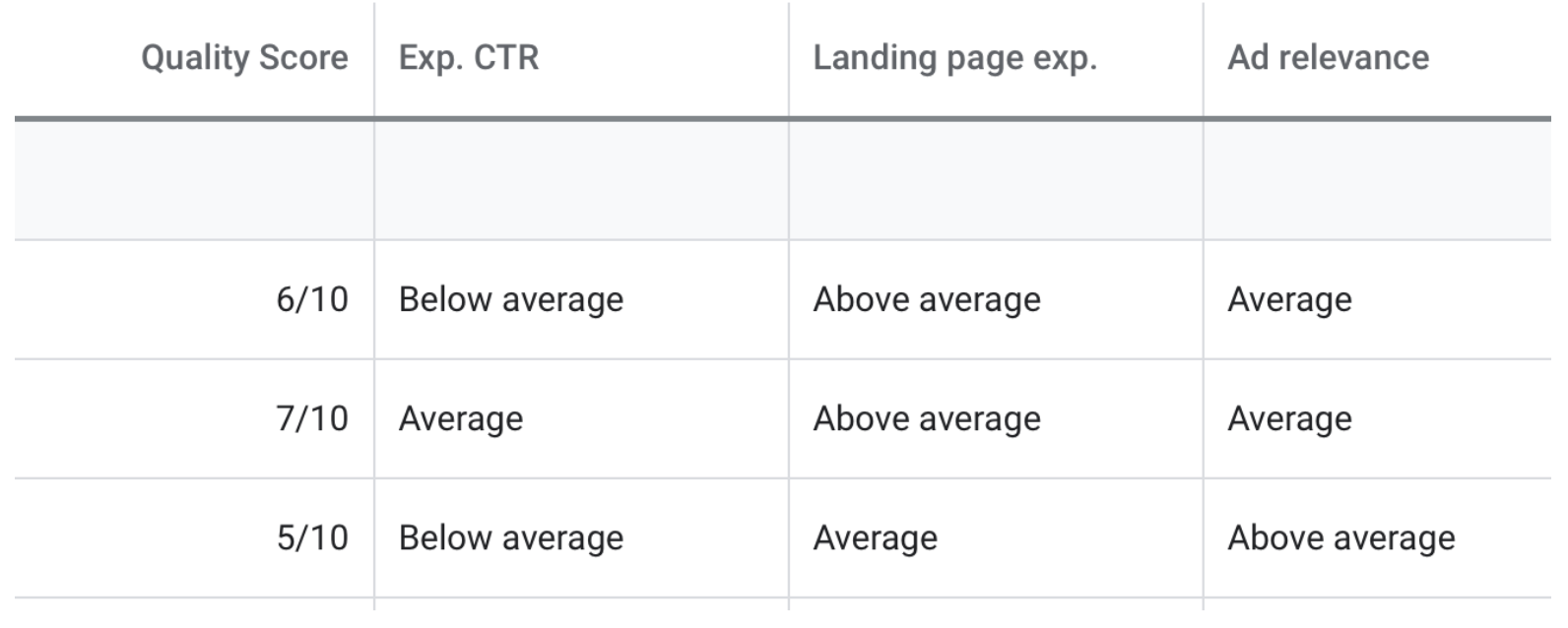
Quick note: only Keywords can have a Quality Score, so you can only view QS numbers when you’re in the Keywords section of your account! Let’s explore each of these elements in turn.
Landing Page Experience
Landing Page Experience is all about whether your website provides a “good experience” to the person who clicks your ad. What does “good experience” mean, exactly? Google is a bit vague about the exact criteria they use. From their support documents: “You should make sure your landing page is clear and useful to customers and that it’s related to your keyword and what customers are searching for.
All these factors can play a role in determining your landing page experience status.” In practice, here’s what I look for when analyzing Landing Page Experience:
- Does the page have annoying pop-ups or distracting elements?
- Does the page contain information, or is it just a big form and nothing else?
- Is the page appropriate for the keyword, or is there a “bait and switch” happening here?
- Is the page fast to load? Does it work on mobile devices and all major web browsers?
It’s possible to drive yourself nuts worrying about all the little things that Google’s looking at.
I care about conversion rate. You should, too.
But you can get very good at generating forms from people you can’t help.
Here’s a simple example. Two landing pages each get 100 paid visits, at the same total ad cost.
Page A gets ten inquiries. Two fit your buying criteria.
Page B gets six inquiries. Four fit.
If all you look at is form conversion rate, Page A wins. It got ten forms instead of six.
But Page B got you twice as many qualified leads for the same money. I’d want to know that before declaring a winner.
This is an illustration, not a client case study. The point is to keep following the numbers beyond the form.
We actually did an in-depth review of the best lead generation website builders for real estate investors on our blog, so check that post out if you want a deeper dive on improving your landing page experience.
Ad Relevance
Ad Relevance is all about whether your ad fits with what Google thinks the searcher is looking for. For example, if you are advertising your home buying services on the keyword “Nike Shoes For Sale,” it’s improbable you’re going to be able to meet that searcher’s needs. Google will thus determine that your ad is not relevant to the searcher and penalize you accordingly. The above example may seem a bit goofy — “I’m a real estate investor, I’d never bid on a keyword about shoes!”
— but keep in mind that broad match and phrase match keywords can get your ad in front of a wide variety of people if you’re not careful. I would not be surprised at all if the broad match keyword property for sale got matched up with Nike Shoes for sale — after all, in Google’s “mind,” shoes are just another type of property! What does Google have to say about Ad Relevance?
“‘Ad relevance’ measures how closely your keyword matches the message in your ads. A below-average score may mean that your ads are too general or specific to answer the user’s query or that this keyword isn’t relevant to your business.” There are two keys to improving Ad Relevance: selecting the right keywords and tailoring your ads. The first is relatively self-explanatory. If your keywords are putting you in front of the wrong people, it won’t matter if you’re the most outstanding real estate investor who ever lived — you’re never going to be deemed “relevant.”
This is one of the potential drawbacks of wider-focused keyword match types like Broad and Phrase match. (Note: if you’re using these broader targeting methods, one of the best ways to make sure you’re getting in front of motivated sellers is to use an effective list of negative keywords for real estate investors). The second method for improving your Ad Relevance is to tailor your ads to the keywords you’re targeting.
Instead of using generic language, use language that speaks explicitly to people using your target keyword. Instead of using the same ad over and over again, create tailored ads for every ad group you create. People using different keywords will respond to other things. Often, they will be more likely to click on an ad that uses the exact language they used when searching. Keep this in mind when creating your ads: more specific language means higher relevancy, more clicks, and more leads.
Expected CTR
Expected click-through rate estimates how likely someone is to click your ad when it appears for a keyword. Google uses past performance and adjusts for factors such as ad position. It is one part of the Quality Score diagnostic, not a simple comparison with one competitor in a fixed position. If this component is below average, review whether the ad speaks to the search and gives the seller a clear reason to click.
Then check actual search terms, clicks, and qualified leads to see what changed. Now that we’ve examined the Google Ads auction and ad quality, let’s talk about bidding strategies.
Understanding Bidding Strategies
Placing your bids on a motivated seller keyword in Google PPC has gotten a lot more complicated in the past few years. There used only to be one or two viable strategies for the average investor. Real Estate Investing has always been, on average, a relatively low-volume market. That meant that a lot of the “fancier” bidding strategies routinely underperformed in real estate investing. (In fact, one of the ways I used to be able to tell if a particular “Google PPC Guru” was full of it or not was by whether they recommended some of these fancy-pants bidding strategies.
If they did, that meant that they only knew “best practice” — and hadn’t tested it out with real investors). However, times change, and the possibilities for real estate investors to get involved in Google PPC have changed as well. For one, Google has come a long way in improving the accuracy and efficiency of some of its bidding algorithms. It used to be that any human could outperform the algorithm if there weren’t a ton of data for Google to feed on.
The amount of data needed for Google to optimize has come down significantly recently, changing that calculus slightly. Secondly, Google has changed various features inside Google Ads that have pushed advertisers towards more “algorithmic” options. They’ve reduced the number of data advertisers get on what, exactly, people are searching for when they see their ads. They’ve reduced or even removed match types, limiting your options for dialing them in.
Furthermore, they’ve also widened what they consider a “close match,” meaning that even Exact Match Keywords target more broadly today than they did a few years ago. All of this adds up to a shifting PPC landscape for investors looking for motivated seller leads. Change is the name of the game in online marketing, and ultimately, it is the companies that adopt the best to those shifting conditions that come out on top.
As a result, I will be covering a wide array of bidding strategies, all of which have worked for us while generating motivated seller leads for our clients. Each has its benefits and drawbacks, and which one ends up being the right match for you will depend mainly on your market, your budget, your risk tolerance, and your close rate.
Types of Bid Strategies: Manual vs. Algorithmic
You can broadly lump bid strategies into two categories: Manual and Algorithmic. You can consider Manual Bid Strategies to be anything where you set your bids yourself. You make the decision; you punch in the numbers. Algorithmic Bid Strategies, on the other hand, are strategies where Google ultimately sets the bids for you. You will often set constraints on what Google can do — for example, by setting a maximum amount you’re willing to spend, or a target that Google should aim for — but by and large, you are letting Google take the wheel and hoping for the best. Let’s start by looking at Manual Strategies.
Manual Bid Strategies
Manual CPC
Manual CPC refers to “Manual Cost-Per-Click.” That means that we are directly setting our maximum bids for every keyword ourselves. This approach gives you, the real estate investor, the most control over where your money goes. You can set a specific bid down to the penny for every keyword you like. Because it’s highly control-focused, Manual CPC works best with account builds that focus on Exact and Phrase match keywords.
That way, you can dial in your bids based on the quality of clicks you expect a keyword to produce. Imagine an ad group in which you are targeting the following keywords: [sell my house fast] “sell my house fast” While these are technically the same keyword, they use different match types. As a result, the phrase match variation (“sell my house fast”) will produce a higher volume and wider variety of clicks than the exact match variation ([sell my house fast]).
Using the Manual CPC bidding strategy, you can factor this into what you pay. For example, if the keyword “sell my house fast” is currently being bid at $10 per click, you may want to bid more for the exact match variation. After all, we know that low-volume and high competition levels often drive prices up for exact match variations. There’s another reason we may want to bid more for an exact match keyword: they tend to generate higher-performing traffic.
Exact match traffic tends to click more, convert more, and close more (see our section on keyword targeting to understand why). The downside to Manual CPC? Labor. To get the most out of this strategy, you need to manually set every bid, which means needing to pay attention to the individual performances of every keyword you’re targeting. If you don’t do that — say, if you just set one bid for all your keywords and forget about it — you’re giving up the single most significant advantage this strategy has (control).
This strategy works best if you’re not targeting a colossal area, have relatively low search volume, and pay much attention to your account. This is not a good strategy if you’re planning to “set and forget.” Just don’t do that at all, OK? Manual CPC also suffers when you’re bringing high volumes of data or using broad match keywords. Data volume is an issue because it means crunching more and more numbers to make wise decisions, increasing the amount of work required.
Broad match keywords are a problem because many of the variations they generate are not visible to the advertiser, giving you less control over your bids.
Enhanced CPC (retired)
Enhanced CPC (ECPC) used to adjust Manual CPC bids using conversion signals. Google retired it for Search and Display campaigns in March 2025. See Google’s current bidding guidance and choose an available strategy based on your conversion data and need for bid control.
Algorithmic Bidding Strategies
Algorithmic bidding strategies are any strategies that rely on Google’s algorithm to set bids dynamically. They come in various flavors, some of which make a lot of sense for investors…and others which don’t. I will say this before we dig in: There is a lot of hype about this kind of thing in the real estate investing industry. Everybody’s talking about AI, machine learning, deep learning, etc.
And yes — sooner or later, this will be how all advertising is done. I believe that. But sooner or later, it isn’t now. We must deal with the technology we have TODAY, rather than the technology we expect to have years from now. The fact is, Algorithmic Bidding Strategies don’t always work for real estate investors. Because REI is so focused on motivated sellers — a niche within a niche and a tiny percentage of the overall housing market — and because the sale-to-close cycle can take so long, it can be challenging for the average investor to utilize these tools.
That’s because all algorithmic bidding processes work best when they have a LOT of data. Take an eCommerce store selling deodorant as an example. They might sell hundreds of deodorant sticks a day and thus have thousands of conversions for an algorithm to work with. That’s a lot of data and a lot of opportunities to test. A real estate investor working with motivated sellers, however, might only get 10-20 high-quality leads a month, depending on their budget.
Even if they close a deal from those leads, that close is likely to happen several weeks or several months after that person converted from website visitor to lead. This makes the optimization process very slow and challenging, even for a company as advanced as Google. I’m not saying these strategies don’t work — and I’m going to explain to you exactly how investors can use them.
What I am saying is that these strategies are still largely situational, aren’t suitable for everybody, and that you take whatever hype that online marketing dude on YouTube is trying to sell you with a massive grain of salt. Cool? Cool. With that out of the way, let’s explore some of the best algorithmic bidding strategies for real estate investors.
Maximize Clicks
This bidding strategy does what it says on the tin: tries to get you as many clicks as humanly possible. Clicks are an odd thing to focus on. After all, clicks cost you money…and just because you got a click does not mean that click is going to turn into a lead. Maximizing clicks can make sense for real estate investors in a few scenarios, however: When you’re very tightly focused: If you’re only running a few particular exact match keywords, maximizing clicks can make sense.
You won’t be worried about optimizing for the wrong people because you’re maintaining a high degree of control over who is seeing your ads. When you’re seeding a dataset: You might optimize for clicks if your area is low-volume, and optimizing for conversions doesn’t make sense for you. At least, while using clicks, you can start to feed Google’s understanding of your account. You might also use this option if you want to speed up a back-end test that’s moving slowly — a landing page split-test, for example.
Maximize Conversions
Maximizing conversions, simply tell Google to go out and get you as many leads as possible within your budget. This is a popular option used in Google PPC accounts targeting motivated sellers. A potential drawback of this approach is that you place no constraints on what Google can bid for a given conversion, as long as it’s within your budget. This can lead to inflated lead costs.
That said, Maximize Conversions is often the best choice of algorithmic bidding options for investors. Why? Because most investors will lack the lead volume needed to effectively utilize bidding options like Target CPA and Target ROAS, which I’ll explain below.
Target CPA
“CPA” in this context stands for “Cost Per Acquisition” — essentially, your cost per conversion. Since most investors count the generation of a lead as a conversion, this boils down to “cost per lead.” In the Target CPA bidding strategy, you give Google a particular target cost you want to spend, on average, for a lead. Google will then look at the auctions for the keywords you are targeting and find opportunities where it thinks it can get a conversion for that amount.
Target CPA is perhaps the second most common algorithmic bidding strategy for real estate investors, and it can often work well. It has a few critical drawbacks, however: If you don’t understand your market and back-end numbers, you can underperform. This point is critical, so let’s examine it for a bit. Costs-per-click in your market is primarily dictated by the amount and intensity of competition you face.
More competitors, spending more money? High CPC. Few competitors with smaller budgets? Lower CPC. Note that no one is checking with you about what you’d “like” to pay per lead. You may have a “target” price for Apple stock, but the market highly values Apple at the moment, you may never end up buying anything. This means that if you set a Target CPA that is below the realm of possibility for your market at the moment, you will not generate much of anything in the way of leads.
Now, that might be a good thing, depending on what your backend numbers are. I’m referring here to your overall close rate for online leads. Let’s say you close, on average, one out of every twenty leads you receive. Let’s also assume that your average profit per deal is $10,000. If you pay $500 for every lead you receive, you will, on average, break even ($500 X 20 leads to close a deal = $10,000).
Anything less than that, and you’re making money. Anything MORE than that, and, well…it’s going to be a sad Christmas this year. Understanding these numbers is critical to understanding whether you’re making or losing money, on average, with your marketing. This may seem basic, but many investors ignore these numbers in the heat of competition. I’ve had multiple clients tell me they will pay “any amount” for leads in their market.
While I appreciate their gumption, those same clients will quickly change their tune once they see their bank accounts emptying. No one can pay infinite money for leads; everything depends on the bottom line at the end of the day. To effectively use Target CPA, then, you must understand both what is realistic for your market, given the competition you face, and your close rate for these leads on the backend.
For these reasons, I prefer to switch to Target CPA once a campaign has had some time to mature, gather data, and establish a performance baseline.
Target ROAS
“ROAS” stands for “return on ad spend.” With this strategy, you tell Google to optimize for whatever keywords will produce the biggest bang for your buck. This is a great strategy, but it was developed for industries with high numbers of conversions and rapid feedback loops for revenue. Imagine an online store selling Widgets; every check out would be a conversion, and could easily feed revenue data back to Google, allowing the algorithm to dial things in accordingly.
Real estate has a timing problem.
Someone clicks your ad today. You talk to them tomorrow. You might not close the deal for another three months.
In the meantime, Google is still making decisions about where to spend your money.
You can give it more useful feedback than “somebody filled out a form.” Qualified leads and closed deals can be sent from your CRM back to Google Ads. Depending on your setup, you can automate that through Google Ads Data Manager, an API connection, or a supported integration. Manual uploads are an option, too.
But connecting the systems is only part of the job.
You need to send the right outcome for the right person, with the correct date and value. You need to avoid duplicates. And you need to check what Google actually accepted, rather than assuming that because something left your CRM, it showed up correctly in your account.
Choosing The Right Strategy For You
If conversion tracking is incomplete or you need close control with low volume, Manual CPC can be a starting point. If you have reliable conversion data and want Google to set bids for conversions, consider Maximize Conversions. Review qualified leads and cost, not only form submissions, before you change the strategy. If volume permits, use a campaign experiment to compare strategies. See Google’s guide to bid strategy experiments.
Types Of Ads: What Real Estate Investors Need To Know
The ads landscape in Google has changed a lot over the past few years. (Maybe you’re noticing a trend?) Again, we see evidence that Google is slowly but surely pushing real estate investors (and everyone else) towards an increasingly automated, AI-driven future. Case in point: Expanded Text Ads.
Expanded Text Ads
Expanded Text Ads are what most people think of when they think “Google Ads.” These were the ads you’d see sitting on top of most search results. They’re text-based with a specified number of allowed characters and some unique features that become available when your ad shows up in the top spot (Ad Extensions, which we’ll discuss later in this article).

Expanded text ads provided high levels of control over your ad copy and ample opportunity for split testing different approaches…if you took advantage of them. We loved Expanded Text Ads so much that they were more or less all we ran. So imagine my surprise when Google ended the creation and editing of Expanded Text Ads on June 30, 2022. Existing ads can still serve.
Google moved new Search ad creation to Responsive Search Ads. Responsive Search Ads are the standard format for new Search ads. But what are they, exactly?
Responsive Search Ads
The best way to explain it is to compare and contrast Responsive Search Ads With Expanded Text Ads. Before Google ended the creation of Expanded Text Ads, the setup screen looked like this:

Here, we’ve got a few different elements: The Final URL, which is where the person who clicks the ad ends up. We’ve got Headlines 1, 2, and 3, which are the most prominent text elements of the ad. Each has 30 characters available. We’ve got the Display Path, which looks like a URL but is just another line for copy. You can put anything in here that you think will entice someone to click — it doesn’t have to point to a real landing page (That’s the Final URL).
Finally, we’ve got Descriptions 1 and 2, which form the “body” of the ad and have 180 characters between them. When advertisers created Expanded Text Ads, they wrote fixed copy for each of these elements. To test fixed copy, advertisers used to create another Expanded Text Ad and compare the two. Now let’s take a look at the creation screen for a Responsive Search Ad.
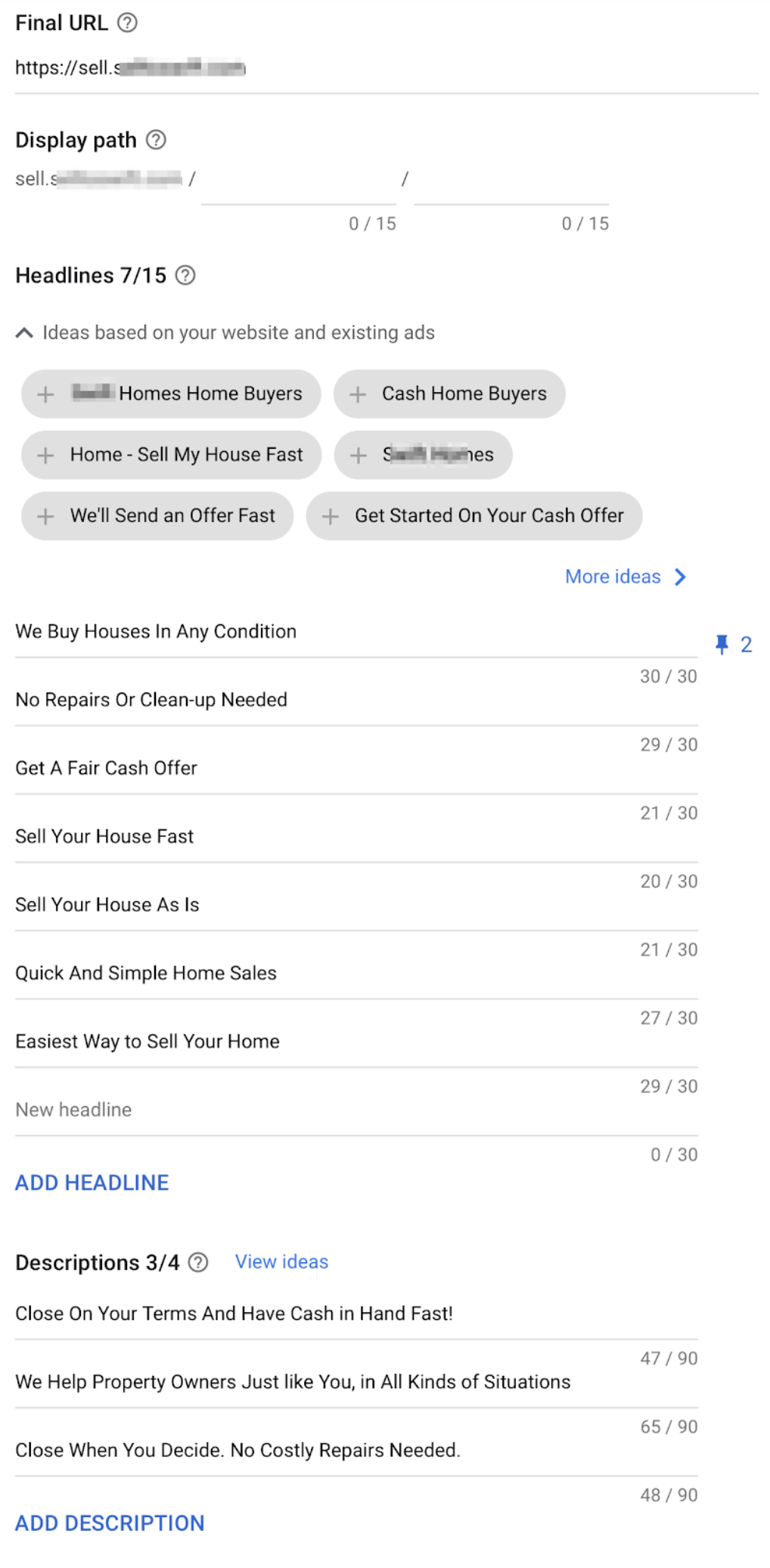
As you can see, we’ve got a lot more going on with this ad type. The fundamental elements remain the same; we’ve got our Final and Display URLs; we’ve got headlines and descriptions. But instead of writing one ad composed of a few different elements, with Response Search Ads, we create many elements that Google will then mix and match based on what it thinks will work best for a particular search.
Think of Expanded Text Ads as giving a child a pre-assembled Lego set, while Responsive Search Ads are like giving a child a pile of Lego pieces. The advantage to Responsive Search Ads is that Google will be able to do far more testing than you would be able to, where you manually keep track of everything. Google will start testing each element against the others, looking for the best combination and the best combination per keyword you are targeting.
This is great in theory, but it’s a mixed bag for real estate investors specifically. Let me explain… Real Estate Investing is, by and large, a lower-volume search market than average. I mean that motivated sellers always make up a tiny portion of the overall housing market. No matter what needs you’re in, most people searching on Google will be retail sellers. That’s just the way it is.
To truly motivate target sellers, real estate investors focus on “motivated” keywords — like sell my house fast, as an example. But these keywords don’t typically get a ton of traffic. Remember: genuinely motivated sellers are a fraction of the overall home-selling public. As such, keywords like sell my house fast, will have dramatically less search volume than keywords like sell my house. This means that the more focused you are on genuinely motivated sellers, the less volume you will see inside your Google Ads account.
This makes “machine learning” based tactics (like Responsive Search Ads) less effective overall because they have fewer data to work with. Here’s the short version: the more significant your focus on motivated sellers, the lower your search volume will be, and the less efficient Responsive Search Ads will be as a result. However, Google’s algorithms have gotten significantly better over the past few years, and it’s easy to assume they will get even better from there.
That will increase the expected results from these ad types. Responsive Search Ads are now the main format for new Search ads. Learn how to write clear assets and review the leads they generate. If you’re a real estate investor exploring Google PPC, start by learning how Responsive Search Ads work. Speaking of improving Responsive Search Ads, I’d like to take a moment to discuss Ad Strength.
Ad Strength is a metric you will now see alongside your ad whenever you create a Responsive Search Ad. The screen looks like this:
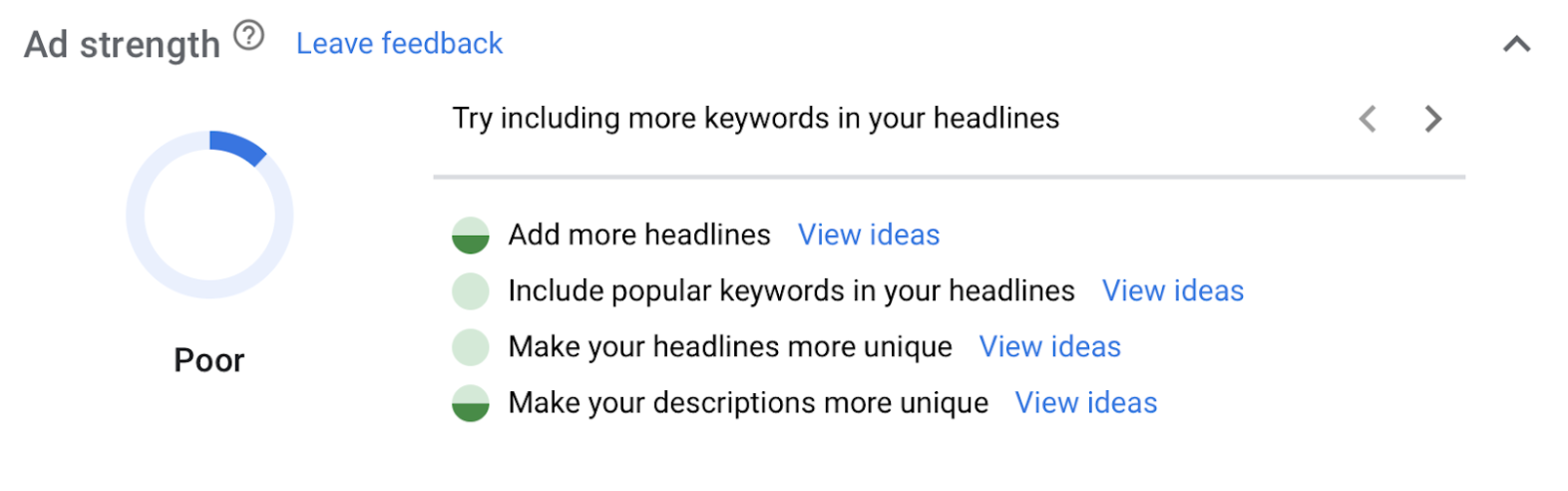
Google gives your responsive search ad an Ad Strength rating and suggestions for improving your headlines and descriptions. Read the suggestions for anything you missed.
Ad Strength itself is not used to calculate Ad Rank. Better ad copy can still help, but a better rating isn't the same as a better result for your business.
If Google calls your ad “Excellent” but the leads are a mess, you have more work to do. If a lower-rated ad brings qualified leads at a cost that works, don't throw it away just to make the dashboard happier.
Phone calls can also come from search ads.
Calls From Search Ads
Google removed the option to create new call-only ads in February 2026. Existing call-only ads will stop receiving impressions in February 2027. To seek phone calls now, use responsive search ads with call assets. Add your business phone number as a call asset, check that the ad and number are approved, and measure the calls and qualified leads you receive. If you still use call-only ads, move to responsive search ads with call assets before the old format stops serving. See Google’s transition guide.
The Best Google PPC Strategies For Real Estate Investors
So far, we’ve covered:
- Why Real Estate Investors should care about Google Ads…
- What Google Ads are, and the various components of Google’s Ad network
- How keyword match types affect the quality of seller leads you to generate
- How there’s no magic list of keywords that will always yield the best results
- How to understand the intent and use that when you choose your keywords
- What the ad auction is, and how it works
- Google’s various bid strategies, their strengths, and their weaknesses
- The different types of ads that are most important for Real Estate Investors
That’s a lot of stuff! But that’s still all it is: stuff. What matters in a practical, motivated seller lead generation campaign isn’t which pieces you use. It’s how you put them together. And THAT brings us into the realm of strategy. Before diving into the two specific strategies we recommend here at AdWords Nerds, we need to take a short diversion into evolutionary biology.
That might seem a bit random, but I promise, understanding what I’m about to show you is going to make EVERYTHING that happens inside your online marketing campaigns make a LOT more sense.
The Red Queen Effect: Why There’s No ONE Perfect Strategy For Your Online Marketing

The Red Queen is a character from Lewis Carroll’s Alice in Wonderland. She features in an odd scene that I was never able entirely to wrap my head around. Alice never could quite make out, in thinking it over afterward, how it was that they began: all she remembers is that they were running hand in hand, and the Queen went so fast that it was all she could do to keep up with her: and still, the Queen kept crying ‘Faster!
Faster!’ but Alice felt she could not go faster, though she had not breath left to say so. The most curious part of the thing was that the trees and the other things round them never changed their places at all: however fast they went, they never seemed to pass anything. ‘I wonder if all the things move along with us?’ thought poor puzzled Alice.
And the Queen seemed to guess her thoughts, for she cried, ‘Faster! Don’t try to talk!’ Alice runs faster, and faster but never makes any forward progress. She’s stuck in the same place she started. The Red Queen Effect is a mental model from evolutionary biology. It describes any situation in which different players are competing for limited resources — like animals in the wild, or like real estate investors in your market.
Let’s take a hypothetical example of competition in nature and imagine how it might play out. Picture a small pond. In this pond, we have two animals in competition: flies and frogs. The frogs want to eat the flies. The flies wish to avoid the frogs. Over time, a balance emerges: the frogs eat some flies, the flies avoid some frogs, and their populations stabilize.
Nature likes randomness, however. Imagine that one frog is born with a unique adaptation: his tongue is extra sticky. Because of this extra sticky tongue, he’s able to catch more flies than average. Soon, the extra-sticky-frog is experiencing a calorie surplus. He’s more robust than the other frogs now — more likely to find a frog princess and have lots and lots of frog babies.
In this way, the extra-sticky-frog DNA is passed down to future generations. This frog’s offspring ALSO have sticky tongues, and they, in turn, are more likely to pass down their DNA. Over time, sticky-tongue-frogs become the dominant frog type in the pond. It’s an excellent time to be a frog. But it’s a bad time to be a fly. There are sticky tongue frogs everywhere!
It’s harder and harder to fly away and thus harder to survive. Who survives this particular frog-pocalypse? Well, as it turns out, one of our fly friends just happens to have a random mutation that helps her out: she’s extra slippery. There’s some kind of weird fly-gunk on her skin that neutralizes the frog’s new extra-sticky-tongues. As time goes by and extra-sticky-tongues become the dominant frog strategy, the value of having extra-slippery skin skyrockets.
Suddenly, having extra-slippery skin is the best way to ensure that you survive to pass down your fly DNA. Over time, extra-slippery-skin flies live longer and pass on more of their extra-slippery DNA. They become the predominant fly variant. Take a step back: where have we ended up? The frogs have developed an extra-sticky-tongue; The flies have developed extra-slippery skin. Each side has upped its game and improved its strategy.
But relative to each other, nothing has changed! The frogs enjoyed a brief period of dominance thanks to their tongues; then, the flies leveled the playing field with their skin. We’ve ended up back at the same place we started: stable populations of both flies and frogs—an evolutionary stalemate. That’s the Red Queen Effect in a nutshell: Any effective strategy is likely to elicit a reaction.
The more effective your plan is, the more your competition will try to undermine it. Why am I spending so much time talking about flies and frogs? Because this same dynamic affects all real estate investor marketing. Develop a particularly unique postcard that gets much higher response rates? Your competitors will copy it, flooding the market and making it less effective. Build an incredible landing page that gets you twice the leads from the same number of clicks?
Copycats will show up everywhere, leading people to get tired of it and click off. Find a new advertising channel that brings you tons of leads at a lower cost than usual? Competitors stampede to take advantage, raising competition, raising prices, and re-establishing equilibrium. The point is not that no strategy works or that coming up with new strategies is pointless. Remember, the frogs enjoyed a moment of competitive dominance.
That was an excellent time to be a frog! The point is that the competitive process never ends. You never stop innovating. You never stop improving your strategy. Furthermore, you never stop testing. Not only that but, you never stop experimenting. The most successful real estate investors doing online marketing now don’t have some secret strategy that magically gets them leads below-market price in perpetuity.
Instead, the most successful real estate investors are committed to the process of continual improvement. They work the system, try new things, invest in what works, and understand that EVERY STRATEGY, no matter how great, will stop working eventually. THAT’s what the Red Queen Effect teaches us. With that understanding, let’s look at the two significant categories of strategy that investors can use in Google Ads: Focus and Volume.
The REI Lead Gen Strategy Matrix
To better understand the strengths and weaknesses of the various strategies — and why you might use one or the other — let’s look at the REI Lead Gen Strategy Matrix.
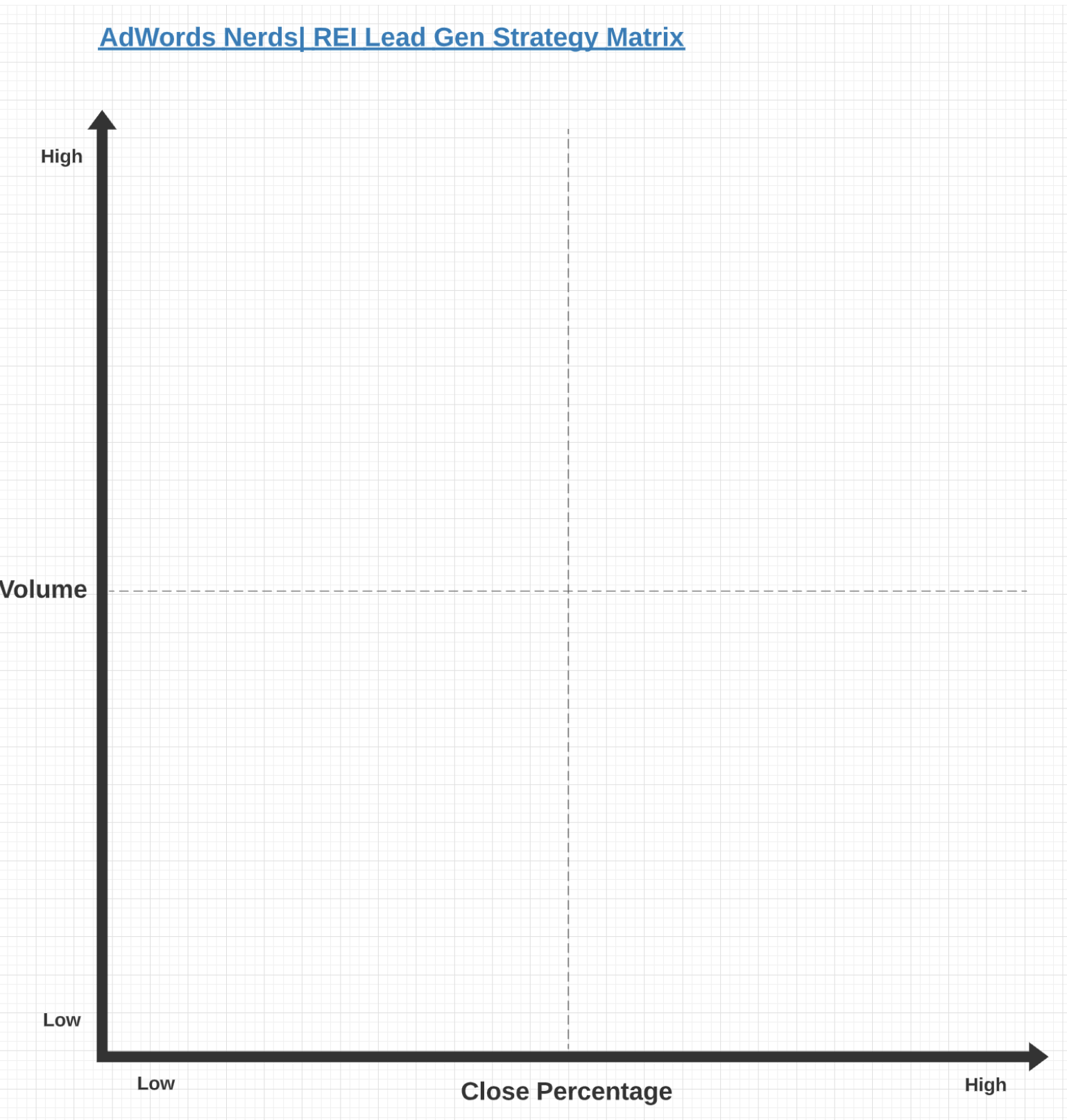
The matrix has two axes upon which we can place any strategy we use to find motivated sellers: Volume (How many leads? How many clicks? How many impressions?) and Close Percentage (How many leads do I need to generate before putting a lead under contract?) It’s important to note that when investors say they want “more motivated” leads, what they mean is that they wish their leads to close more often; in other words, they want a higher closing percentage.
Of course, there are many ways of improving your closing percentage outside your Google Ads strategy (better sales tactics, better or faster follow up, more aggressive offers, etc.), but those are outside the scope of this guide. All strategies that real estate investors use strike some kind of balance between lead volume and close percentage. For example, here are some of the most common real estate investor marketing channels plotted on the matrix:
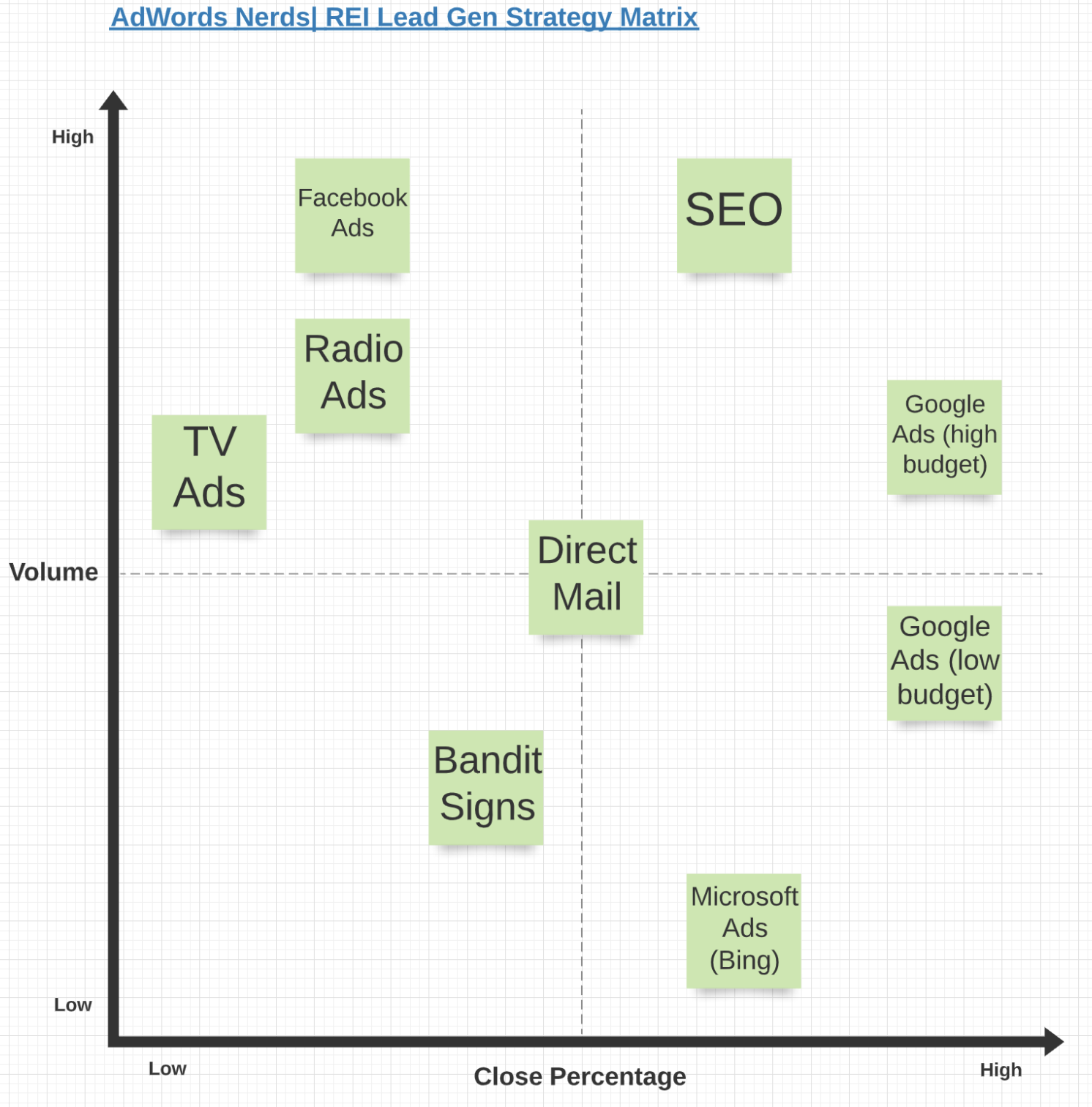
You may have a different opinion on which channels go where, but the more significant point is that each has a unique set of tradeoffs. After all, genuinely motivated sellers represent only a fraction of the larger housing market. Because of this, if you only target the most motivated sellers, you will, by necessity, lower your overall lead volume. Conversely, if you broaden your targeting and pull in more of the overall housing market, your lead volume (as well as cost per lead) will go up; but since you’re pulling in more retail sellers, your overall close rate will go down.
The perfect balance between these two competing forces will vary depending on your risk tolerance, budget, market, competition level, etc. Your closing ability, the types of deals you want to do or are willing to do, the size of your market, the state of the economy in general, and the housing market, in particular, will all play a role in which strategy you end up choosing.
But we don’t need to stop there. We can also plot specific strategies within a given channel on the REI Lead Gen Strategy Matrix. Let’s do that for Google PPC now.
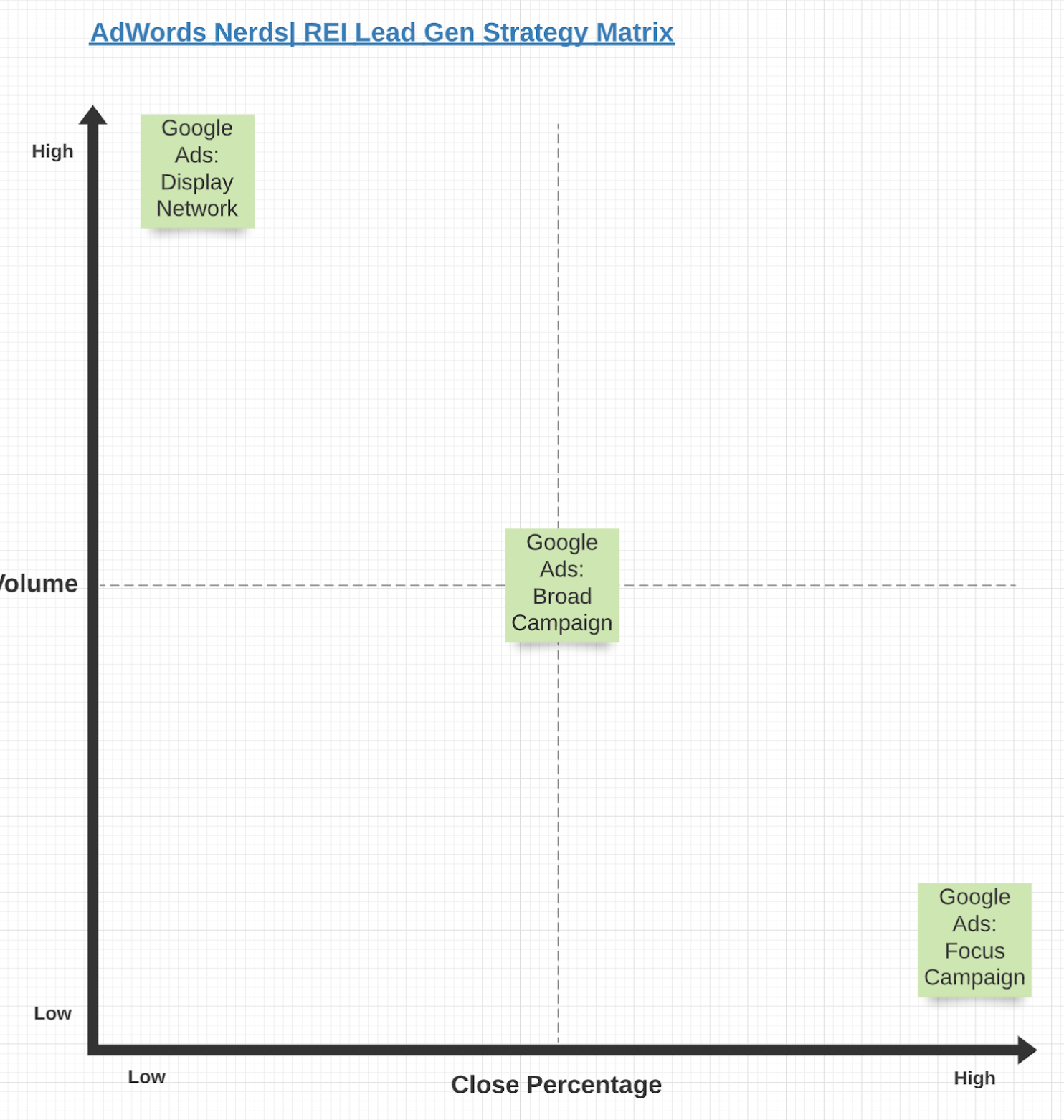
Here we’ve got three strategies for contrast: Display Network, Broad Campaigns, and Focus Campaigns. You can see from the chart that Display Network campaigns tend to be extremely high volume and a meager close percentage. This is the proverbial “fire hose” strategy: hundreds of clicks a day, but very little in the way of quality leads. Since these campaigns are extremely rare in real estate investing, we’ll focus on the remaining two strategies: Broad and Focus. Let’s start with Focus Campaigns.
Focus Campaigns
The goal of a Focus Campaign is to produce the highest-possible quality leads. To achieve this, the investor is willing to get fewer leads overall and to pay a premium for the leads they do get. In exchange, they see (in our experience) close rates in the 1/10 to 1/6 range (extremely high for this marketing channel). Focus campaigns share the following characteristics:
- Usage of primarily exact match keywords
- Focus on manual CPC bidding strategies
- Tight segmentation (by device, day of the week, time of day, geography, etc.)
Focus campaigns are all about the “80/20”: going after the small percentage of leads that will result in the highest possible revenue. These campaigns can be astonishing, and they were the predominant campaign type we ran at AdWords Nerds for nearly a decade. They still work great and are a great starting point for any real estate investor because they’re intentionally small and minimize the number of elements that need to be managed.
They DO need to be actively managed, however, and that brings us to some downsides of focus-based campaigns. For one, this is NOT a “set and forget” strategy. Because the cost per click for the best keywords tends to be relatively high in real estate investing, every mistake is costly in a Focus campaign. Every element of the campaign must be optimized for the investor to acquire leads at an acceptable cost.
That means paying attention to your account, knowing what the data tells you, and acting accordingly. That brings us to the second downside of the Focus approach, which is data velocity. Because these campaigns are tightly targeted, they tend to generate data (impressions, clicks, leads) very slowly. This means that the cycle time on any given test — whether that’s split testing an ad or trying out a different landing page design — is long.
Take landing page split testing as an example. You’ve got two designs that you want to try out in your Focus campaign, so you set up a campaign experiment for each page and sit back to await the results. Let’s assume that, for the test to be conclusive, you’d like to get at least 100 clicks on each page. Many Focus campaigns, depending on the size of the market and their budget, are lucky to get 100 clicks in a month.
Divided evenly between the two landing page variations, that’s 50 clicks each — meaning it’ll be two full months before your test concludes. If the results are pretty close, you might need to run it even longer! This slow testing environment can lead many investors to lose track of what they were doing and never capitalize on the performance improvements testing can bring. Expanded to all the elements of the account — ads, keywords, bid strategies, account segments, etc.
— this can lead to extreme under-optimization over time. That’s disastrous in a campaign like this. That brings us to the second common Google Ads strategy for real estate investors: Broad Campaigns.
Broad Campaigns
The goal of a Broad Campaign is to strike a balance between lead volume and close percentage. To accomplish this, the investor broadens their targeting and takes advantage of some of Google’s automated tools. This tends to increase their lead volume and lower their cost per lead…but at the expense of a lower close rate. Broad campaigns share the following characteristics:
- Usage of broad match and phrase match keywords to allow for greater impression volume
- Use of automated bidding strategies (like Target CPA)
- Larger target areas/markets
Broad campaigns have a few advantages that make them effective: For one, their cost per click tends to be much lower than with Focus campaigns, decreasing the penalty for tests that don’t work out. Secondly, utilizing Google’s automated bidding strategies allows for rapid optimization, provided enough volume is present (Google needs you to feed it data to work…and the more, the better). Finally, because there’s a higher volume of data coming into the account, the testing cycle tends to be much shorter than with Focus campaigns, allowing for faster landing page split testing and so on.
The downside of all this data flow is that much of it will be off-base. You’re going to generate more retail leads and more leads out of your target area (we have noticed a significant increase in out-of-market leads using this strategy, despite efforts to prevent them). This strategy also works best if you’re going after a large geographical area. That’s because the more data you feed the system, the more chances it has to learn and the more efficient it becomes.
Running automated bidding strategies in low-volume markets will produce lots of noise without the efficiencies you get from the AI — the worst of all possible worlds. It’s also important to note that, past a certain point, efforts to “improve lead quality” are self-defeating with this type of campaign. Yes, indeed, pause keywords that produce nothing but junk…but remember that this entire strategy is predicated on balancing lead volume with quality.
If you zero in on quality too much, you’ll end up with a Focus campaign. If that’s the right strategy for you, great — but know that that’s what you’re doing, and be aware of the downsides that come with it.
Putting It All Together: Tips and Resources For Getting Deals From Google PPC
We’ve covered a monumental amount Google Ads knowledge in this guide. You’ve learned:
- Why Google PPC is a critical marketing channel for every serious real estate investor
- How to target only the most motivated sellers in your market
- How to beat the ad auction and get leads for less
- How to improve your account performance over time
- The types of ads and bidding strategies that will give you a competitive edge
- How to pick the right strategy for YOUR business (and why there’s never just “one” best way to go)
But how do you put it all together? Where do you go from here? I’d like to share some valuable resources and tips to guide you on the next stage of your lead generation journey. First off, if you need help or advice, my team and I can help. All we do all day is help real estate investors find more deals with Google, and I know we can help you too.
Feel free to grab a spot on our calendar so we can help build you a custom marketing strategy for your real estate investing business. Secondly, make sure to check out our YouTube channel. I’m posting tips, tricks, case studies and walk throughs in there every single week. Not only is it free, it’s better than most of the other paid programs out there. Make sure you’re in the REI Marketing Nerds Facebook group.
Not only is it a wonderful community of investors looking to master PPC, SEO, and more, I’m also in there each week answering questions and providing feedback. Finally, I host the REI Marketing Nerds Podcast every single week. Advice, tips, what’s working now, and awesome interviews with REAL investors. It’s available anywhere you get your podcasts! The absolute best tip I can give you? Just get started.
You can’t learn to ride a bike from a book, and eventually you’re going to need to try your hand at actually running some Google Ads. Skip past the “Google Ads Express” and all the automated options they give you. Play around with the settings. Explore the campaign creation process. Get your hands dirty! It’s the best way to learn. I can’t wait to see what you do.
Please reach out if you have any questions! Yours, Dan Barrett and the whole AdWords Nerds team.

About The Author
Dan Barrett is the Head Nerd at Adwords Nerds. He’s been helping real estate investors with their online marketing since 2010.
He is the voice behind the REI Marketing Nerds Podcast and the AdWords Nerds YouTube Channel.